

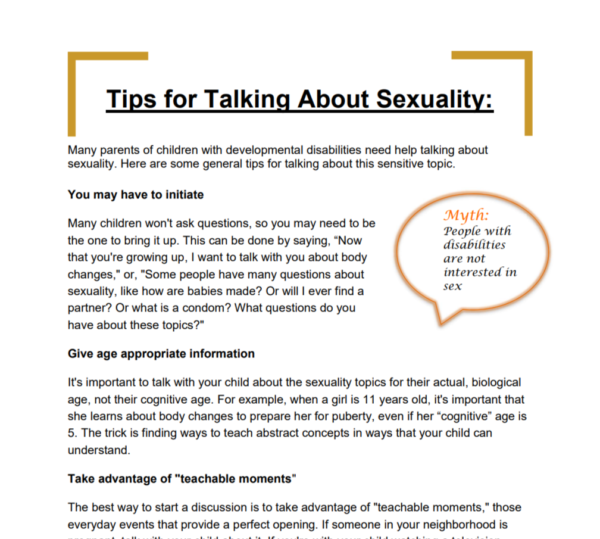
This handout is a practical, reassuring guide to help parents and caregivers talk openly with children and teens with developmental disabilities about bodies, boundaries, and relationships.
It offers concrete, step-by-step suggestions for starting conversations, giving age-appropriate information, and using everyday “teachable moments” to build comfort and confidence over time.
This handout highlights simple strategies that make sensitive topics more manageable, including:
- Initiating conversations when children do not ask questions on their own
- Keeping explanations short, clear, and concrete
- Using visuals, books, and role plays to practice skills in a safe setting
- Staying calm when questions or behaviors catch you off guard
- Partnering with trusted helpers and local resources for extra support
Grounded in a positive, rights-based view of sexuality and disability, this resource emphasizes that ongoing, honest conversations help young people build self-respect, safety, and healthy communication skills.
Ideal for: parents, caregivers, and family members of children and teens with developmental disabilities, as well as educators, clinicians, and support professionals coaching families on how to talk about sexuality.
Note: This document description was co-created with AI and reviewed by the Elevatus team for accuracy.
Ready to take action?
- Browse Elevatus Curricula & Online Workshop Series
- Become a Sexuality Educator
- Complete One of Our Self-Study Courses
- Register for Upcoming Workshops
By Katherine McLaughlin
Katherine McLaughlin, M.Ed., AASECT Certified Sexuality Educator, is the Founder, CEO, and Lead Trainer for Elevatus Training. She has been a sexuality educator and trainer for over 30 years. As a national expert on sexuality and intellectual and developmental disabilities, she trains professionals and parents, as well as people with I/DD, to become sexual self-advocates and peer sexuality educators.
