

Summary
This article is part of Elevatus Training’s Sexual Rights series. Download the full Sexual Rights Toolkit to explore all 10 rights with activities for self-advocates and supporters.
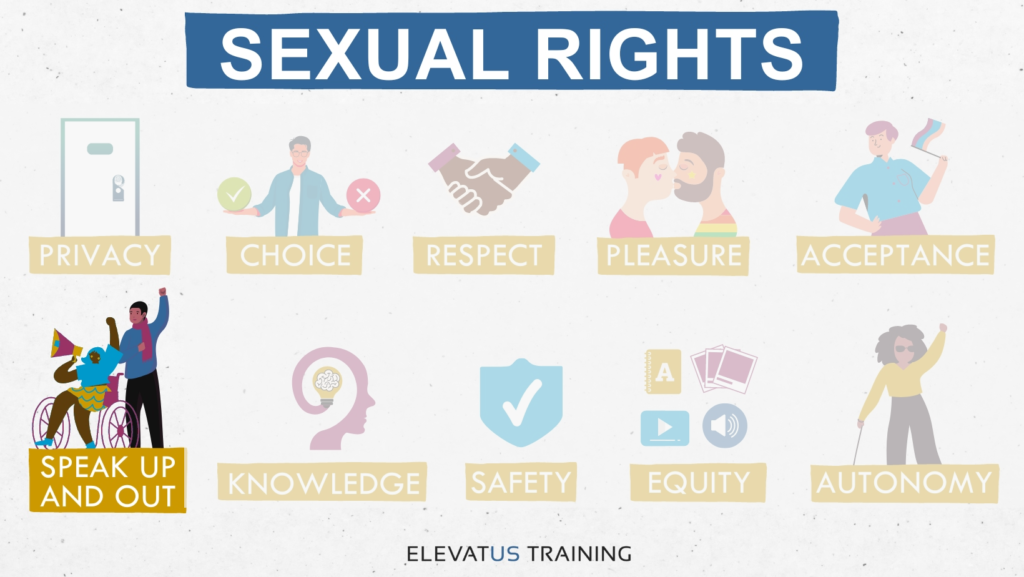
People with intellectual and developmental disabilities (I/DD) have the right to speak up when they are hurt, abused, or their rights are violated. In this article, you will learn what the sexual right to speak up and out means, as wel as three ways you can support self-advocates in speaking up and reporting.
What Is the Sexual Right to Speak Up and Out?
The sexual right to speak up and out means people with intellectual and developmental disabilities (I/DD) have the right to say something when someone has hurt their body or feelings, or when their rights have been violated. It also means knowing their rights and being able to report abuse to someone who will listen.
I saw a bumper sticker once that said, “Speak your mind, even if your voice shakes.” I found that idea so comforting because I often put pressure on myself to sound perfect and confident, even when I don’t feel confident and am very nervous.
It’s almost like the most important part of speaking up is sounding good rather than saying what I feel, especially if I feel hurt or if my rights were violated. But actually, what’s most important is saying it and not keeping it inside.
“I have a right to speak up and speak out if someone has hurt my body or my feelings. I have a right to tell someone if my rights have been violated.”
Where These Sexual Rights Come From
The rights in this series are drawn from a Sexual Rights Statement developed by the Sex Education Implementation Oversight Committee to support the implementation of the Illinois law Public Act 101-0506. The committee, which included self-advocates, compiled what they believe are the rights. Self-advocates and the Illinois Self-Advocacy Alliance then created Easier-to-Understand versions of these statements, which have also been translated into Spanish, Simplified Chinese, and Polish. You can read the full Sexual Rights Statement on the Illinois Department of Human Services website.
Learning Objective: Speaking Up About a Rights Violation
For self-advocates: to be able to speak up or report when they have been hurt or violated, and to understand what their rights are in order to speak up about a rights violation.
For professionals: Support others in speaking up or reporting when they are hurt or violated, and ensure they know their rights and what to do if those rights are violated.
3 Suggestions to Support Speaking Up
1. Try this model as a way to speak up.
There are times when we are hurt by others. For example, a friend forgets you had dinner plans and doesn’t show up. Or someone calls you a mean name. We can feel very hurt, and sometimes we decide it is important to say something to the other person. But do we sometimes just “let it go” or feel uncomfortable, so we keep it to ourselves?
Lots of people struggle to tell others that they hurt them. It is good to share our feelings respectfully when others hurt us. Also, sometimes we don’t say anything because we don’t want to hurt the other person’s feelings, but then we suffer. We need to pay attention to our own feelings and know that they matter, rather than worrying about others’ feelings. The other person needs to take care of their feelings, not us.
2. There are also other serious violations.
Those may require us to stay away from the person and talk with someone else. If someone abuses (verbal, physical, or sexual) you or violates you in some way, it’s important to speak up. Even if you are somewhere that you weren’t supposed to be or doing something unsafe. That doesn’t matter.
You were violated or abused, and the person was wrong and needs to learn how to show respect and not abuse others. Who in your life can you tell if someone violates you? What if that person doesn’t believe you? Go to someone else and just keep telling until someone listens. Here is a hotline number if you need to report:
National Sexual Assault Hotline — available 24 hours: 1-800-656-4673. Your state may also have a hotline to report abuse, too.
3. Knowing your sexual rights is very important.
If you are speaking up about something you have the right to speak up about and people don’t listen, that could be a rights violation. For example, let’s say you are 25 years old and in a relationship, and someone at your group home tells you that you can’t be alone with your partner in your room. You have the right to privacy. If you keep asking and you are still not allowed, you can reach out to your state advocacy center or disability rights center to discuss your situation. Here is the National Disability Rights Network website to find your state’s telephone number.
Inspiration and End Result
If this happens, people with I/DD will have better relationships, support if they have been abused, and their sexual rights will be honored, not taken away.
Self-Reflection and Call to Action
For Self-Advocates
- What gets in your way of speaking up?
- How can you get better at speaking up?
For Professionals/Parents
- How can you encourage those you support to speak up?
- What do you already do to encourage this?
- What can you change to encourage this to happen?
Key Terms
- Abuse is when someone hurts or treats another person in a very bad and harmful way. Abuse can be emotional, physical, and/or sexual. Abuse is wrong, and you should tell a trusted adult if it happens to you or someone you know.
- Advocate means to speak up for or support something or someone you believe in.
- Boundary means a line or a rule that shows what is okay and not okay. Boundaries can be physical, meaning about a certain space, or personal, meaning about a person’s body. Boundaries should not be disrespected or ignored.
- Privacy is a human right. It means being able to keep your personal things and information to yourself, without others knowing or seeing them.
- Self-advocate is a person with an intellectual or developmental disability who speaks up for their needs, rights, and interests.
Ready to take action?
- Browse Elevatus Curricula & Online Workshop Series
- Become a Sexuality Educator
- Complete One of Our Self-Study Courses
- Register for Upcoming Workshops
By Katherine McLaughlin
Katherine McLaughlin, M.Ed., AASECT Certified Sexuality Educator, is the Founder, CEO, and Lead Trainer for Elevatus Training. She has been a sexuality educator and trainer for over 30 years. As a national expert on sexuality and intellectual and developmental disabilities, she trains professionals and parents, as well as people with I/DD, to become sexual self-advocates and peer sexuality educators.
